- Hablamos Español

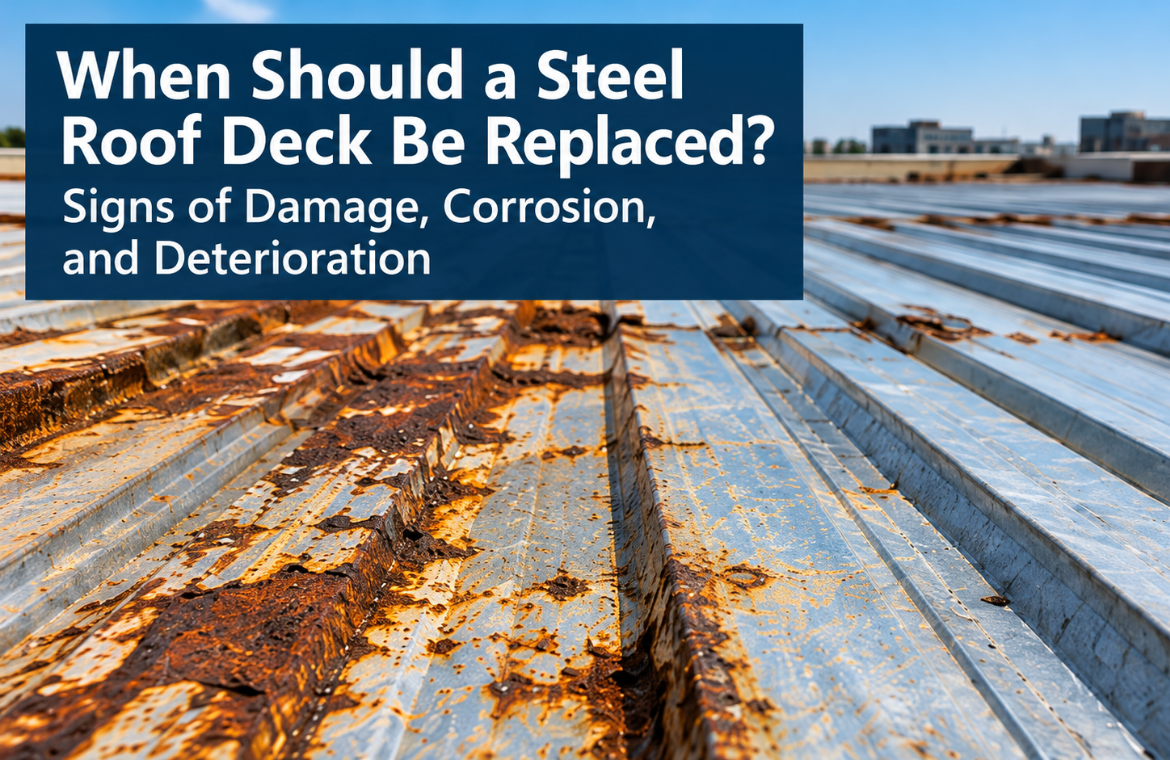
When Should a Steel Roof Deck Be Replaced? Signs of Damage, Corrosion, and Deterioration
Steel deck is designed to provide dependable structural support for many years. However, like any building component, exposure to moisture, physical damage, changes to the building, and years of service can affect its condition.
Determining whether an existing steel roof deck can remain in place or needs replacement requires more than simply looking for visible rust. Contractors, building owners, architects, and engineers need to consider the extent of the damage, its location, and whether the deck can continue to perform the structural role for which it was designed.
Understanding the warning signs can help project teams identify potential problems early and determine when a more detailed structural evaluation is needed.
Surface Rust Does Not Always Mean Replacement
Rust is one of the first things people notice when inspecting older deck. However, not all corrosion has the same structural significance.
Light surface rust may affect appearance without substantially reducing the thickness of the steel. More advanced corrosion can cause pitting, scaling, or actual loss of material.
The location of the corrosion matters as well. Moisture that repeatedly reaches the same areas can cause deterioration around fasteners, laps, penetrations, and bearing points.
When evaluating a metal roof deck, the goal is to determine whether corrosion is primarily superficial or whether enough steel has been lost to affect structural performance.
Removing loose material and closely examining the deck can help reveal the actual condition, but decisions involving structural capacity should be made by the appropriate design professional.
Look for Holes and Significant Material Loss
Holes are a more obvious sign that deterioration has progressed.
Small isolated openings may occur because of corrosion or previous construction activity. Larger areas of material loss can indicate that moisture has been affecting the deck for a considerable period of time.
Particular attention should be given to areas beneath roof leaks, around drains, near mechanical equipment, and around roof penetrations.
A steel roof deck relies on its formed profile and remaining steel thickness to transfer loads to the supporting structure. Significant loss of material can reduce that ability.
Simply covering a deteriorated area does not restore the original steel.
Watch for Bent or Crushed Ribs
Damage is not always caused by corrosion.
Construction activity, equipment installation, falling objects, or improper loading can bend or crush portions of the deck profile. The ribs are an important part of how the deck carries loads across the span.
A dent does not automatically mean that an entire panel must be replaced, but severe deformation deserves careful evaluation.
Contractors should also look for damage near supports. Distortion at these locations can be particularly important because the deck transfers loads into beams, joists, or other supporting members there.
Check Connections and Fasteners
The condition of the deck itself is only one part of the inspection.
Connections between the deck and supporting structure should also be considered. Missing, damaged, loose, or deteriorated attachments may prevent the system from performing as intended.
Side laps should be inspected where applicable. Areas that have separated or shifted may indicate previous movement or installation problems.
The condition of a metal roof deck should therefore be evaluated as part of the overall structural assembly rather than as an isolated sheet of steel.
Pay Special Attention to Roof Leaks
Water intrusion is one of the most important warning signs because moisture can remain trapped within a roofing assembly.
A leak visible inside a building may originate somewhere else on the roof. Water can travel before reaching the deck, which means the visible stain may not identify the full affected area.
When roofing materials are removed during reroofing or renovation, contractors have an opportunity to inspect areas that may not have been visible previously.
Discoloration, scaling, holes, and deteriorated connections should be documented so the project team can determine whether repairs or replacement are necessary.
Consider How the Building Has Changed
Older buildings are often renovated for purposes that were never anticipated when they were constructed.
New mechanical equipment may be added. Roof mounted units may become heavier. New openings may be cut through the deck. Solar equipment or other rooftop systems may change loading conditions.
These changes do not necessarily mean the existing deck is inadequate, but they can affect the structural evaluation.
The original steel roof deck was selected based on a particular profile, gauge, span, support condition, and design load. Changes to the building may require engineers to verify whether those original conditions still apply.
Replacement May Be Localized or Extensive
Finding damaged deck does not always mean replacing the entire roof.
Sometimes deterioration is concentrated around a leak, drain, penetration, or another localized condition. In other projects, widespread corrosion may affect large areas.
The appropriate solution depends on the condition of the existing material and the design requirements of the project.
One challenge in renovation work is identifying a replacement profile that works with the existing structure. Older buildings may contain deck profiles or dimensions that are less common today.
Accurate measurements of rib depth, rib spacing, sheet width, gauge, span, and support conditions can help when identifying potential replacement material.
Have Structural Damage Properly Evaluated
Visual inspection is useful for identifying possible problems, but determining structural capacity requires appropriate engineering judgment.
When corrosion, deformation, missing connections, or material loss appears substantial, an engineer can evaluate whether the existing system remains adequate and determine what repair or replacement approach is appropriate.
The decision should be based on the actual condition of the deck, required loads, span, support configuration, and project specifications.
Start With the Existing Conditions
Replacing deteriorated deck is easier when the project team knows exactly what is already installed.
Before ordering replacement material, document the profile, dimensions, gauge if known, support spacing, finish, and extent of deterioration. Photographs and drawings can also help communicate existing conditions.
Marlyn Steel manufactures a range of roof and floor deck products for commercial construction. When replacement material is required, providing accurate project information helps identify options that can be reviewed against the project specifications.
Leave A Comment